Manna
The church grounds its understanding of sacraments in the ministry of the priesthood, and in a charge it attributes to God’s instruction to Aaron of the House of Levi:
“Gather the manna... distribute it to each man and woman and child according to their need.”
In the biblical narrative of Exodus 16, manna is the bread from heaven given to Israel in the wilderness; each household gathered “every man according to his eating,” and Aaron was told to lay up an omer of it “before the LORD.”2
Kykeon and the Eleusinian Mysteries
For many centuries, until the late fourth century AD, initiates of the Mysteries of Demeter and Persephone at Eleusis, near Athens, drank a sacred barley drink called the kykeon before the climax of the rite.3
Contested In The Road to Eleusis (1978), R. Gordon Wasson, the chemist Albert Hofmann — who first synthesized LSD from ergot — and the classicist Carl Ruck proposed that the kykeon contained ergot, a fungus that grows on grain.3 Brian Muraresku’s The Immortality Key (2020) extended the argument to a possible psychedelic wine in early Christianity.4 Neither thesis is accepted as proven by most classicists and historians.
Soma and haoma
The Rig Veda devotes an entire book to Soma, a plant pressed into a sacred drink and praised as a god; its Avestan counterpart is haoma in the Zoroastrian tradition.5
Contested The plant has never been identified with certainty. R. Gordon Wasson argued for the fly agaric mushroom (1968); others have argued for ephedra; David Flattery and Martin Schwartz argued in Haoma and Harmaline (1989) for Syrian rue.5 See also Amanita muscaria.
Syrian rue
Syrian rue (Peganum harmala) grows from the Mediterranean to Central Asia. Its seeds contain the harmala alkaloids harmine and harmaline, and they are still burned as incense in parts of the Middle East and Central Asia.6 Harmala alkaloids are also found in the vine used in ayahuasca.
Blue lotus
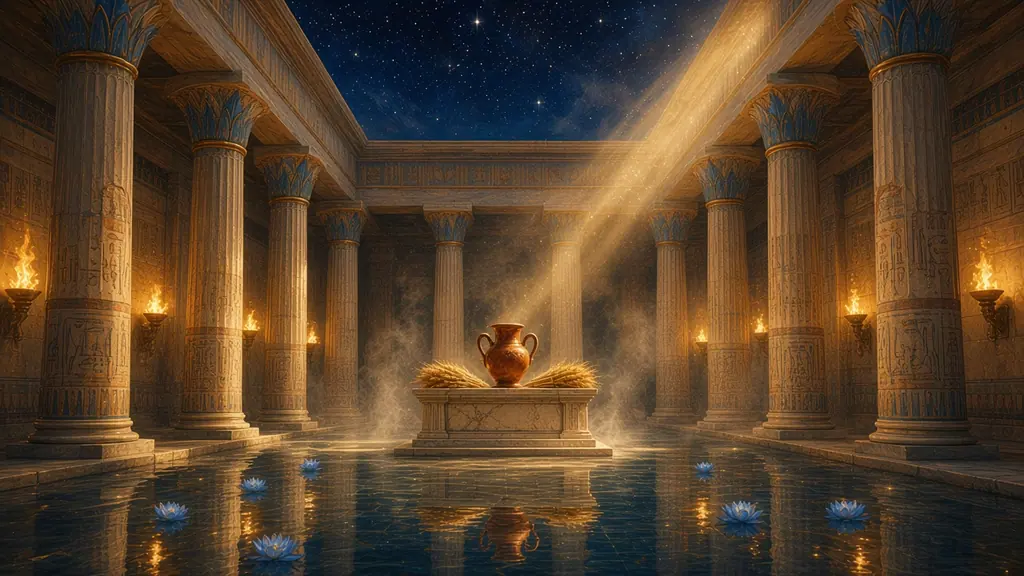
The blue water lily of the Nile (Nymphaea caerulea) appears again and again in ancient Egyptian art, and it was a symbol of the sun and of rebirth.7
Contested Whether Egyptians used the flower for its effects in ritual has long been debated, because the evidence was mostly iconographic. In 2024 a team led by Davide Tanasi reported traces of blue water lily and of Syrian rue in a Ptolemaic Egyptian Bes vase of the second century BCE — chemical evidence that the question is not merely speculative.10
Iboga and Bwiti
Iboga (Tabernanthe iboga) is a rainforest shrub of west-central Africa. Its root bark, which contains ibogaine, is the sacrament of Bwiti, a religion practiced in Gabon — where it is recognized as one of the country’s official religions — whose central rite is an initiation with iboga.89 Some Bwiti communities have incorporated Christian elements.
To read how the church understands these traditions within Christianity, see Psychedelic Christianity and the church’s Historical Foundations.
Questions and answers
Was there a psychedelic in the kykeon of Eleusis?
In The Road to Eleusis (1978), R. Gordon Wasson, Albert Hofmann and Carl Ruck proposed that the kykeon drunk by initiates contained ergot, a grain fungus. The theory remains contested.
What is Syrian rue?
Syrian rue (Peganum harmala) is a plant of the Middle East and Central Asia whose seeds contain harmala alkaloids. It is burned as incense in parts of the Middle East, and some scholars have proposed it as the ancient haoma or Soma.
What is iboga?
Iboga (Tabernanthe iboga) is a shrub of west-central Africa whose root bark is the sacrament of Bwiti, a religion of Gabon whose initiation centers on it.
Sources
- Official Lawful Notice — The Church of the Only Begotten Son
- Exodus 16, the manna in the wilderness (KJV) — Bible Gateway
- Kykeon — the drink of the Eleusinian Mysteries, with references
- Muraresku, The Immortality Key: The Secret History of the Religion with No Name (St. Martin’s Press, 2020)
- Soma (drink) — the identification debate, with references
- Peganum harmala (Syrian rue) — botany and history, with references
- Nymphaea caerulea (blue lotus) — botany and history, with references
- Bwiti — religion of Gabon, with references
- Tabernanthe iboga — botany and history, with references
- Tanasi et al., “Multianalytical investigation reveals psychotropic substances in a Ptolemaic Egyptian vase”, Scientific Reports 14 (2024) 27891
Scholarly claims about sacred plants in history are summarized with their sources, and contested claims are marked as contested. The church’s own beliefs are quoted exactly and linked to the page where they appear.