St. Peter II and the church
In its Historical Foundations, the church names the saints it honors:
“The Church of the Only Begotten Son with deepest honor and reverence, also observes the sacred work of St Peter I, with whom Christ left the keys of heaven, and St. Peter II, who so named the San Pedro cactus thusly, and All Original Christians.”
The church also describes a ceremonial tradition of its own: “Sacred Sacramental Ceremonies, practices and accurate research describing the events of the 24-36 hour ceremonial process.”1
Peyote
Peyote (Lophophora williamsii) is a small, spineless, slow-growing cactus of the Chihuahuan Desert of southern Texas and northern Mexico. Its principal active alkaloid is mescaline. In 2005 a team led by Hesham El-Seedi analyzed two peyote specimens from Shumla Caves in Texas: radiocarbon dating placed them at about 3780–3660 BCE, and they still contained mescaline — physical evidence of use going back nearly six thousand years.2
The Native American Church
Peyote is the central sacrament of the Native American Church, incorporated in Oklahoma in 1918, whose ceremonies join Indigenous tradition and, for many members, Christian faith.3 After the Supreme Court’s 1990 decision in Employment Division v. Smith, Congress amended the American Indian Religious Freedom Act in 1994 to protect “the use, possession, or transportation of peyote by an Indian for bona fide traditional ceremonial purposes in connection with the practice of a traditional Indian religion.”4 Federal regulations separately exempt “the nondrug use of peyote in bona fide religious ceremonies of the Native American Church.”5 Colorado’s Natural Medicine Health Act expressly excludes peyote from the state’s definition of natural medicine.6 The legal history is told on the religious freedom page.
San Pedro
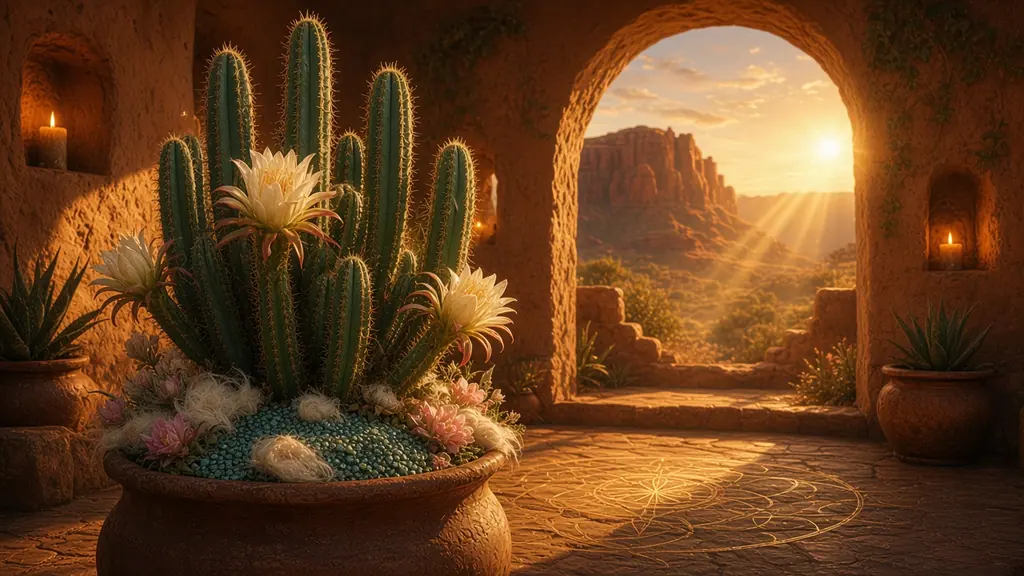
San Pedro (Echinopsis pachanoi, also classified as Trichocereus pachanoi) is a tall, columnar cactus of the Andes of Ecuador and Peru, with large white night-blooming flowers. It too contains mescaline.7 Carved stones at Chavín de Huántar, the Andean temple of the Chavín culture (about 1200–500 BCE) and a World Heritage Site, are widely read as depicting the cactus.97 Ethnobotanists trace its healing use in northern Peru back some two thousand years to Moche culture,10 and a 2022 study of human remains from Peru’s south coast reported chemical evidence of mescaline-containing cactus use in the Nasca era.8 Its Christian name is commonly explained by St. Peter, keeper of the keys of heaven; the church honors St. Peter II for the name.
Read more in the church’s Declarations and Beliefs and the sacraments overview.
Questions and answers
How old is the religious use of peyote?
Peyote buttons from Shumla Caves in Texas have been radiocarbon dated to about 3780–3660 BCE — nearly six thousand years ago — and still contain mescaline, according to a 2005 study.
Is peyote protected for religious use?
Federal law protects the use of peyote by Indians for bona fide traditional ceremonial purposes in connection with traditional Indian religions (42 U.S.C. § 1996a), and federal regulations exempt the nondrug use of peyote in the religious ceremonies of the Native American Church. Colorado’s Natural Medicine Health Act expressly excludes peyote.
Why is San Pedro called San Pedro?
A common explanation links the name to St. Peter, who holds the keys of heaven. The church honors “St. Peter II, who so named the San Pedro cactus thusly.”
Sources
- Historical Foundations — The Church of the Only Begotten Son
- El-Seedi et al., “Prehistoric peyote use: alkaloid analysis and radiocarbon dating of archaeological specimens of Lophophora from Texas”, Journal of Ethnopharmacology 101 (2005) 238–242
- Native American Church — history and legal recognition, with references
- 42 U.S.C. § 1996a — Traditional Indian religious use of peyote (Cornell LII)
- 21 CFR § 1307.31 — Native American Church (Cornell LII)
- C.R.S. § 12-170-104, Natural Medicine Health Act definitions
- Echinopsis pachanoi (San Pedro cactus) — botany and history, with references
- Socha, Sykutera & Orefici, “Use of psychoactive and stimulant plants on the south coast of Peru from the Early Intermediate to Late Intermediate Period”, Journal of Archaeological Science 148 (2022) 105688
- Chavín (Archaeological Site) — UNESCO World Heritage List
- Bussmann & Sharon, “Traditional medicinal plant use in Northern Peru: tracking two thousand years of healing culture”, Journal of Ethnobiology and Ethnomedicine 2 (2006) 47
Scholarly claims about sacred plants in history are summarized with their sources, and contested claims are marked as contested. The church’s own beliefs are quoted exactly and linked to the page where they appear.